Five hours
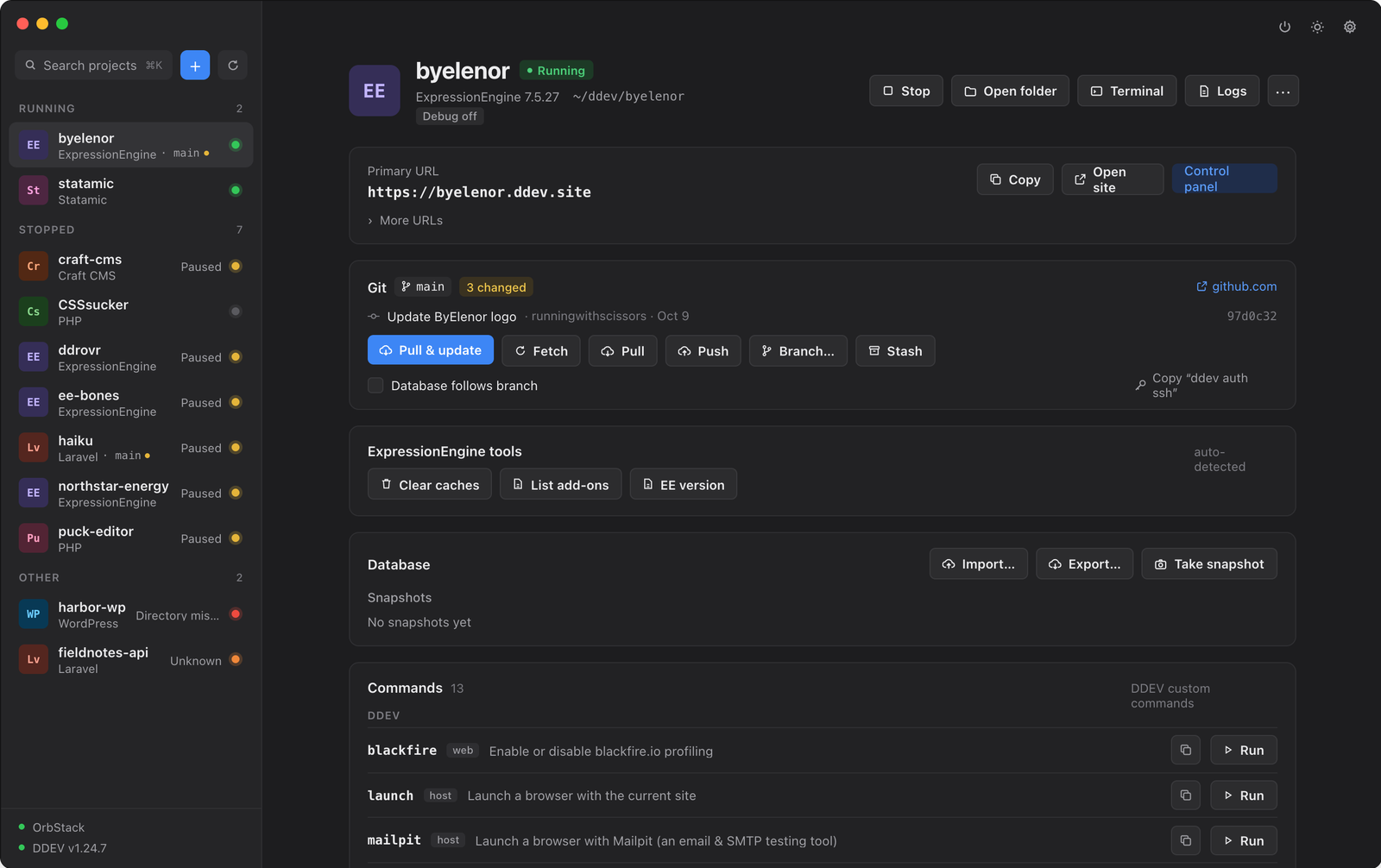
Recently I had an idea for a native macOS app called DDrovr: a visual desktop interface for DDEV, meant to give developers something closer to what Herd gives Laravel developers.
Normally, an idea like that kicks off a substantial process. Research. Product definition. User flows. Interface design. Technical architecture. Swift development. Testing. Revision. Probably several people, and probably several weeks before anyone could click on anything real.
Instead, I used AI throughout the workflow. ChatGPT helped me work through product strategy and scope. Claude and AI design tools helped me explore user flows, screens, and interactions. ChatGPT and Claude together helped turn that thinking into a detailed technical scope and implementation prompt. Then Claude Code built the app in Swift.
Not a mockup. Not a clickable prototype. A working app.
It connected to my actual DDEV installation and discovered all 15 of my projects. It reported their status, started and stopped them, streamed their output, watched for changes made outside the app, and handled errors. It shipped with automated tests: 65 test cases across 14 suites. All of them passed.
From the first idea to a working, tested native macOS app took no more than five hours. Not five days. Five hours.
I'm still processing that.
The highs
I'll start with the good part, because it's real and I don't want to bury it.
Every creative person I know has a graveyard of ideas. A notes file, a folder of sketches, a list of "someday" projects that never got built because the distance between the idea and the thing was too long. Too many hours, too many skills you didn't have, too many people you couldn't afford. Most good ideas don't die because they're bad. They die of logistics.
That distance just collapsed. An idea I'd normally have parked for a year became something I could install and use before dinner. That's not a small change in productivity. It's a change in what's worth attempting.
There's also a kind of joy in it I didn't expect. Watching something you described take shape, then pushing back on it, then watching it get better, feels a lot like the best parts of working with a great team. The iteration loop is so short that you stay in the creative state instead of drifting into project management.
And for a small studio, the math is different now. One person with clear judgment can ship things that used to require a department. That's a genuine opportunity, and I'd be lying if I said I wasn't excited by it.
The lows
Now the other part.
The "several people" that project would have needed aren't hypothetical. They're designers, front-end developers, Swift developers, QA testers. People I've hired, worked beside, and mentored. Some of them are people I used to be. When five hours replaces several weeks of several people, the excitement comes with a quiet question about where that work went.
There's a personal version of that question too. A lot of what I spent decades getting good at was craft: the patience to push pixels until they were right, the muscle memory of writing the same patterns a thousand times, the knowledge of where the bugs usually hide. Watching a tool do in minutes what took me years to learn is humbling in a way that isn't entirely comfortable. Some of that skill is now worth less, and it's strange to admit that out loud.
Then there's the business side. If something takes five hours, how do you price it? Clients read the same headlines we do. The value of the work hasn't changed, but the perceived cost of producing it is falling fast, and that gap is going to be negotiated in a lot of uncomfortable meetings.
I also worry about the next generation. The tedious, mechanical work AI is best at is exactly the work that used to train juniors. It's how many of us learned to see. If the bottom rungs of the ladder disappear, I'm not sure how anyone builds the judgment I'm about to say matters so much.
And the goalposts keep moving. Every time I've said "it still can't do X," a release or two later, it could. That pattern is hard to unsee.
What didn't become irrelevant
I don't buy the argument that AI is just hype anymore. I've seen what these tools can do when they're used seriously. But I also don't think the lesson is that experience no longer matters.
DDrovr exists because I knew what I wanted to build. I understood the audience and the problem. I could evaluate Local, Herd, and DDEV and see where the gap was. I knew which ideas were useful and which were unnecessary. I knew when the UX was wrong, and which technical compromises were acceptable.
None of that came from the AI. The AI was fast because I was clear. Hand the same tools to someone without that context and you get something that compiles, runs, and solves the wrong problem.
Twenty-five years of experience didn't become irrelevant. It became leverage.
What AI dramatically compressed was the distance between a decision and a finished artifact. It's getting frighteningly good at the mechanics: moving rectangles, writing code, generating production assets, turning specifications into working software.
That doesn't make judgment less valuable. It makes judgment the whole game.
What should we make?
Who is it for?
What problem are we actually solving?
What should we leave out?
What deserves to exist in the first place?
Those are the questions that decided whether DDrovr was worth five hours. The tools didn't ask any of them.
For now
I want to be honest about the two words doing the most work in this article: for now.
It would be comforting to end on "judgment is the one thing machines can't do." I'm not sure that's true, and I don't think anyone else is either. Five years ago I'd have said writing a tested native app was safely human work. The line keeps moving, and I'd rather admit that than build my identity on the assumption it stops right where I happen to be standing.
So I've stopped asking whether AI will make me obsolete. That question either has a terrible answer or no answer yet, and neither helps me work tomorrow. The better question is what I'm uniquely positioned to contribute right now, and how I keep sharpening it.
For me, the answer is taste, context, and responsibility. Knowing an audience. Knowing a market. Knowing what it feels like to be the person using the thing. And being the one accountable when it's wrong. A tool can produce an answer. Someone still has to decide it's the right one and put their name on it.
Somewhere in between
I've watched people in our industry split into two camps. One treats every new model as the arrival of the future and outsources their thinking to it. The other insists it's all a parlor trick and refuses to look closely. Both feel safer than the middle. Neither is a good place to stand.
I think the most useful place to be is somewhere between blind enthusiasm and outright denial. Curious enough to use these tools seriously. Experienced enough to recognize where they fail. And stubborn enough to keep making the important decisions ourselves.
Some days that position feels like riding the best wave of my career. Other days it feels like watching the tide come in. Most days it's both.
I built a working app in five hours. I'm proud of it, and I'm unsettled by it. I've decided that's an honest place to be.